Lessons from 7 years of teaching Japanese to English speakers
Ask a Japanese learner whether they understand は and が, and you’ll often hear the same answer: “I kind of get it.”
Then you give them a question to answer, and they get it wrong.
I’ve been teaching Japanese for 7 years, and this pattern has barely changed. Many students nod at the explanation, feel they’ve understood, and then freeze or guess when they have to choose a particle in real time. In my experience, very few students are convinced by explanation alone.
This article covers why explanations rarely fix は and が, the rule of thumb I give my students, and the kind of practice that actually works. At the end, you’ll find 10 practice questions with answers so you can try it yourself.
A typical mistake
Someone asks:
誰が来ましたか? (だれがきましたか, dare ga kimashita ka) (Who came?)
And the learner answers:
田中さんは来ました。 (たなかさんはきました, Tanaka-san wa kimashita)
It sounds slightly off. The natural answer is:
田中さんが来ました。 (たなかさんがきました, Tanaka-san ga kimashita)
The question asks who, so the name is the new information, the thing the other person wants to know. That is exactly the job が does. If you answer with は, you’re treating “Tanaka” as something both people already know about, which doesn’t fit the question.
This is the mistake I see most often, and it shows up even in students who can recite the rule perfectly.
A rule of thumb
Here is the version I give my students:
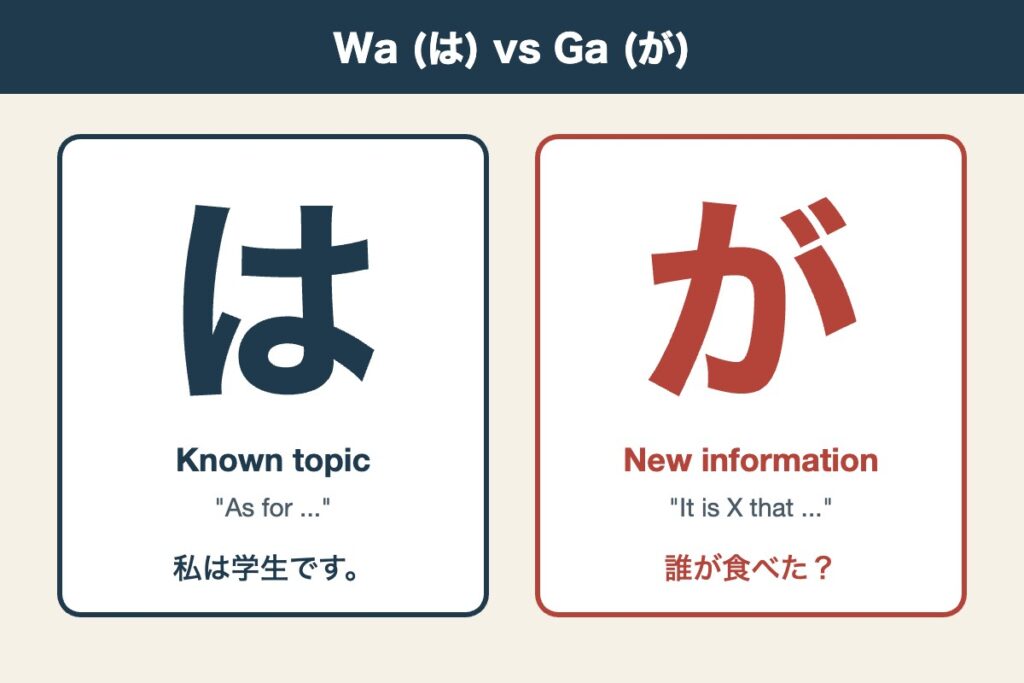
- は marks something both people already know about: the topic.
- が marks new information.
Let’s look at two short examples.
A: 田中さんはどこに行きましたか? (たなかさんはどこにいきましたか, Tanaka-san wa doko ni ikimashita ka) (Where did Tanaka go?)
B: 田中さんは大阪に行きました。 (たなかさんはおおさかにいきました, Tanaka-san wa Osaka ni ikimashita) (Tanaka went to Osaka.)
Here both people already know who Tanaka is, so 田中さん takes は.
A: 誰が窓を開けましたか? (だれがまどをあけましたか, dare ga mado o akemashita ka) (Who opened the window?)
B: 私が開けました。 (わたしがあけました, watashi ga akemashita) (I opened it.)
Here the speaker wants to know who, so the answer, 私, is new information and takes が.
I want to be honest: this is a simplification, not the whole story. Japanese has plenty of exceptions and special cases, and you’ll meet them as you go. But as a starting point, “known topic vs. new information” gets you surprisingly far, and it’s easy to use while you’re speaking.
Why understanding it isn’t enough
English has no particle that does this job. English speakers show a similar difference through word order, stress and articles (“a man came” vs “the man came”), but you don’t have to think about it, because it comes naturally in your own language.
In Japanese, you have to make that choice consciously, at speed, in the middle of a sentence. Understanding the rule helps you check your answer afterwards. It doesn’t help you produce the right particle on the spot.
That’s why longer explanations tend not to help. In my lessons, students who nod at a detailed explanation often make the same mistake again in the very next sentence. Understanding and using are two different skills, and only one of them can be trained by listening to an explanation.
What works: lots of small, quick answers
In my lessons, I keep the explanation short and move straight to practice. The cycle looks like this:
- I give a short question-and-answer pair with the particle missing.
- The student fills it in, quickly, without long thinking.
- If they’re wrong, I explain on the spot, briefly.
- We go straight to the next one.
Fill-in-the-blank is the format I use most. If the goal is to really master は and が, I’ll do around 20 of these in a single lesson. The point isn’t to test the student. It’s to give their ear and their instinct enough repetitions that the right particle starts to feel natural.
A few things make this kind of practice work better:
- Use question-and-answer pairs, not single sentences. The question gives you the context that decides which particle fits. A sentence on its own often has no single right answer.
- Answer fast. If you have time to build a rule in your head, you’re practising the rule, not the instinct.
- Say the sentences out loud. Hearing yourself say 田中さんが来ました makes it stick better than just writing it.
- Check right away. The sooner you find out you’re wrong, the better the correction sticks.
Try it yourself: 10 practice questions
Choose は or が for the blank in each question. Tap an answer to see why, with the full sentence and its English translation.
PRACTICE QUIZ
How to make your own drills
You don't need special materials. Take any short conversation and delete the particle:
- Write a question that uses a question word (誰 dare, 何 nani, どれ dore). The answer to these usually takes が.
- Write a question about someone or something that has already been mentioned. The answer usually takes は.
- Write two or three sentences of a very short story, where a new character appears and is then talked about again, like the grandfather example.
- Ask a friend or a teacher to check them.
If you use AI to make your own drills
A lot of learners now generate practice sentences with AI, and for this particular topic it is a reasonable idea: the drills that work for は and が are short, repetitive and endless, which is exactly the kind of material that is tedious to write by hand. You can ask for twenty sentences with the particle removed and get them instantly.
There is one caveat, and it comes from using these tools in actual lessons rather than from theory. In my experience the sentences themselves are usually fine, but the answers are not reliable. Even at N5 and N4 level (material that looks trivially easy), AI tools still pick the wrong particle a noticeable proportion of the time, and they do it with complete confidence. When I generate practice material for a lesson, I check every answer before putting it in front of a student, and I find mistakes often enough that skipping the check is not an option.
This matters more for は and が than for most grammar points, because the whole difficulty is that both options are grammatical. A wrong answer key does not look wrong. If you drill against it, you are not practising the distinction. You are training yourself into the opposite of it, and undoing that takes considerably longer than learning it correctly the first time.
So: use AI to generate the sentences, by all means. But treat the answer key as a draft rather than an authority. If you have access to a teacher, or a native speaker who is willing to look at twenty sentences, have the answers checked before you start drilling. This is one of the clearer cases where a human is still doing something the tool cannot: not explaining the grammar, which AI does perfectly well, but telling you reliably which answer is right.
You will forget. That's normal.
Even when this practice works, students forget over time. Anything you don't use for a while fades, and は and が are no exception. When it happens, the fix is the same as before: go back to the practice questions for a while. It's not a failure. It's just part of learning.
Do you really need to get it right?
Honestly, it depends on your goal. In everyday conversation, people will usually understand you even if you mix up は and が. A particle mistake in ordinary speech rarely stops someone from getting your meaning.
It matters more if you're preparing for an exam like the JLPT, where particle questions are tested directly.
So if you're travelling or learning for fun, don't let this one particle slow you down. If you're aiming for the JLPT, treat it as something to drill, not just to read about.
Common questions
Is は always the topic and が always the subject?
Roughly, yes: は marks the topic and が marks the subject. But the two aren't always the same thing, and a sentence can have both. 私は猫が好きです (わたしはねこがすきです, watashi wa neko ga suki desu) means "As for me, I like cats." The topic is 私 (は), and 猫 is the thing that is liked (が). That's a good example of why practising full sentences beats memorising a single rule.
Why do answers to "who" questions use が?
Because the answer to "who" is the new information. The person asking doesn't know it yet. That's the core idea of が.
Can I leave the particle out?
In casual conversation, yes. People often drop は and が, for example: ご飯、食べた? (ごはん、たべた, gohan, tabeta) But learners usually get better results by learning the full forms first, then noticing the casual versions in real speech.
How long does it take to master は and が?
It varies a lot from person to person, and it depends on how much you practise. I'd rather not give a number. What I can say is that regular practice with question-and-answer pairs works much better than reading more explanations.
Should I memorise the rule or just practise?
Learn the rule of thumb so you understand the idea, then spend most of your time practising. The rule helps you check your answers. The practice is what makes them automatic.
About the author: written by an Iroha Passport teacher. Iroha Passport is a Japanese language school offering private lessons and travel Japanese courses.
Try a lesson
If you want someone to check the drills you are using, or work through the particles that keep tripping you up with you, a trial lesson is the easiest way to start: 45 minutes one to one with a native Japanese teacher, in English.
Related reading: How long does it take to learn Japanese? · Learning Japanese online from the UK
Lessons are one to one, taught in English by native Japanese teachers.