By Iroha Passport — Japanese lessons & Japan travel planning, London
If you are planning your first time in Japan and feeling a little nervous, the short version is that you’ll be fine. For a first-timer, Japan is about as easy, safe and kind as any country in the world, and most of the worries that keep people up at night before the flight turn out to be nothing at all.
We are Iroha Passport, a UK-based team of native Japanese planners and teachers who help UK travellers plan their trips and learn the language. Our planners grew up with Japan’s trains, onsen and konbini, so this is not a listicle scraped from other blogs. These are the japan travel tips first-time visitors actually need, written by people who call the place home.
Let us walk you through what really matters, what you can happily ignore, and what will pleasantly surprise you. There is a pre-trip checklist near the end too.
Why Japan Is So Easy for a First-Time Japan Trip
Here is the reassuring truth first. Japan runs on quiet, reliable systems. Trains arrive to the minute. Streets are clean and safe, even late at night. Staff are unfailingly polite and will go out of their way to help you, often walking you to where you need to go rather than just pointing.
You do not need to speak Japanese to get around. You do not need to be an experienced traveller. What trips people up is not danger or difficulty, it is the small unfamiliar customs, and those are quick to learn. Once you understand a handful of them, the whole country opens up.
So let’s demystify the parts that make newcomers anxious.
Cultural Etiquette That Actually Matters
There is a lot of scary-sounding etiquette content online that makes Japan feel like a minefield. It is not. Most Japanese people know you are a guest and will forgive almost anything. But a few things really do matter, and getting them right will make locals warm to you instantly.
Shoes come off more than you expect
In homes, many traditional restaurants, ryokan (inns), temples and some changing rooms, you take your shoes off. The clue is usually a small step up and a shelf of slippers. If you see others in socks, follow suit. To save embarrassment, wear socks without holes, and slip-on shoes make your life far easier than laced boots.
There are often separate toilet slippers too. Change into them for the bathroom, then change back. Forgetting and wandering out in toilet slippers is a classic first-timer moment, and honestly, most Japanese people find it endearing rather than offensive.
Onsen and public bathing
The onsen (hot spring) can feel intimidating, but the rules are simple. You wash and rinse thoroughly at the seated showers first, then get into the communal bath already clean. No swimwear. The small towel does not go in the water; people rest it on their head or the side. Tie long hair up.
Bathing is one of the loveliest parts of a trip once the nerves fade. One thing to check in advance: some onsen still have rules about tattoos, though this is slowly relaxing. If you have ink, you have options: look for tattoo-friendly onsen (increasingly common, and easy to find with a quick search), cover a small tattoo with a waterproof patch, or book a room with a private bath, whether a kashikiri (reservable) bath or an onsen ryokan with in-room baths, so you can soak without a second thought.
Quiet on the trains
Japanese trains are notably calm. People do not take phone calls, and conversation is kept low. You will see signs asking you to set your phone to silent (manner mode). It is not a rule you will be told off for breaking, but matching the quiet is a small courtesy that locals really appreciate.
Tipping culture: please do not tip
This surprises a lot of UK visitors. There is no tipping in Japan, anywhere. Not in restaurants, not in taxis, not for hotel staff. Good service is simply the standard, and leaving money can cause genuine confusion, with staff sometimes chasing you down the street to return it. Just say “gochisousama deshita” after a meal instead. It means thank you for the food, and it is worth far more than coins.
Trash bins and carrying your rubbish
Public bins are rare, and this catches everyone out. This dates back to the mid-1990s and never really reverted. You will finish a drink and have nowhere to bin the bottle. The solution locals use is simple, they carry a small bag and take their rubbish back to the hotel or a konbini bin. Do not eat while walking in busy areas either; find a spot to stand, or eat near where you bought it.
Getting Around: Simpler Than It Looks
IC cards are your best friend
Get an IC card (Suica, Pasmo, ICOCA and others are all the same idea). It is a tap-and-go card for trains, buses, konbini, vending machines and lockers. You tap in and out at station gates and it just works. You can add a Suica or Pasmo straight to an iPhone’s Apple Wallet and top it up with your card, which we genuinely recommend for a first trip, with no queuing at machines. Two things to know: Mastercard and Amex top up more reliably than UK Visa cards (if Visa is rejected, just add cash at a konbini), and Android phones bought outside Japan usually can’t add a Suica, so Android users should pick up a physical card on arrival, or use the visitor-focused Welcome Suica Mobile app on iOS.
Google Maps does the hard part
Google Maps is remarkably good in Japan. It gives you exact platforms, which train car to board, transfer timings and the fare. Trust it. Between Google Maps and your IC card, navigating Tokyo becomes remarkably stress-free, even with zero Japanese.
The shinkansen (bullet train)
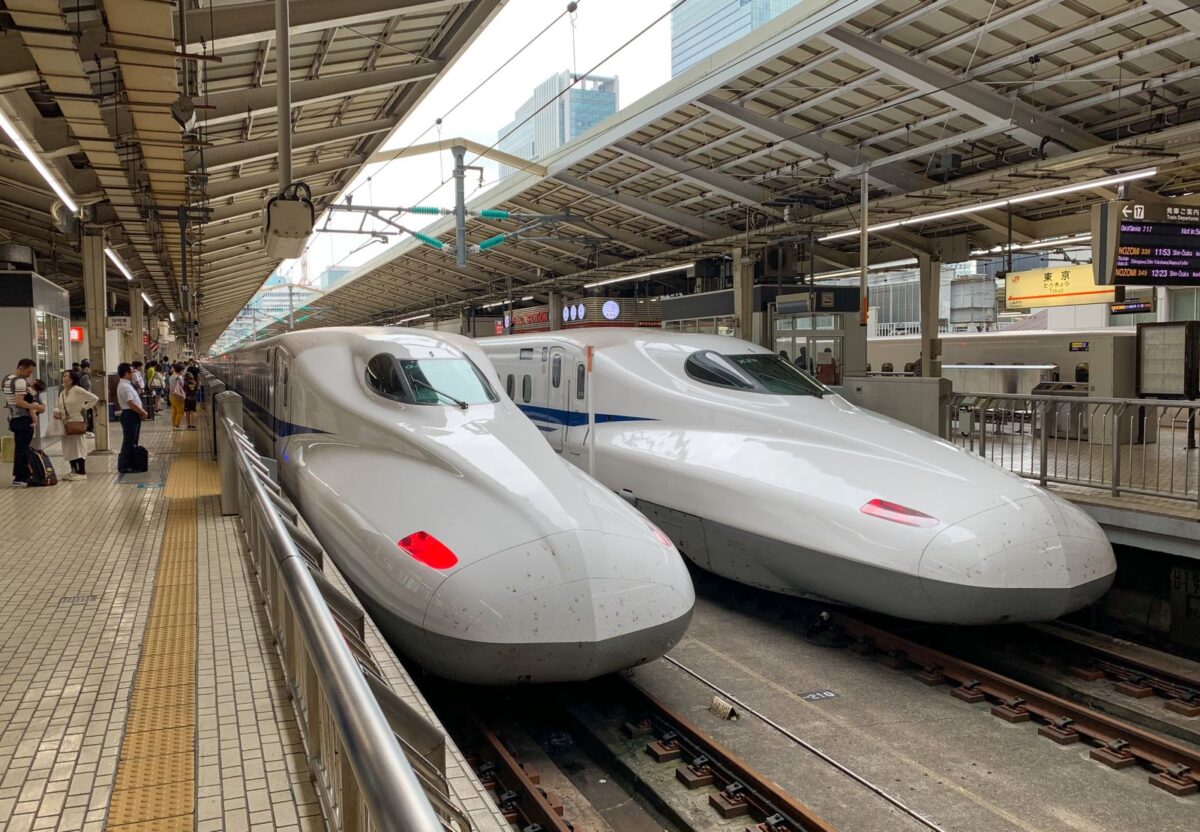
The shinkansen is a joy: fast, smooth, punctual and comfortable, with more legroom than any flight. If your trip covers several cities, look into whether a rail pass or individual tickets suit you better, because the maths changed in recent years and a pass is not automatically the cheapest option anymore. As of 2026 the 7-day pass is ¥50,000 (around £260), and for a classic Tokyo–Kyoto–Osaka trip individual tickets usually come out cheaper, and the pass really earns its keep only on longer, faster-moving routes. One more thing: the pass doesn’t cover the fastest Nozomi trains without a surcharge, so with a pass you’d take the slightly slower Hikari.
For a full step-by-step on stitching these journeys together, our guide on how to plan a trip to Japan from the UK (linked at the end) walks you through it.
Connectivity, Money and the Practical Bits
Staying connected
You will want data from the moment you land, mainly for Google Maps and translation. The easiest option now is an eSIM you buy before you fly and activate on arrival, so you are online the second the plane doors open. Pocket Wi-Fi rental is the alternative if you have several devices or a group sharing one connection. Either works; an eSIM is usually simpler for a solo traveller or couple.
Cash vs card
Japan has a reputation as a cash country, and while cards are far more accepted than they used to be, especially in cities, cash still matters. Small restaurants, older shops, some temples, shrines and rural spots may be cash only. Our advice is to carry more cash than you would at home, and use 7-Eleven ATMs, which reliably accept foreign cards and have English menus. Coins add up fast here, so a small coin purse is well worth having.
Power and adapters
Japan uses Type A plugs (the flat two-pin) and runs at 100V. UK travellers need an adapter. Most phone and laptop chargers handle the voltage automatically, but check the label on anything with a heating element, like hair tools, before you plug it in.
Common First-Timer Worries (And Why to Relax)
“I don’t speak Japanese, will I cope?” Yes. Signage in cities is bilingual, staff are patient, and translation apps cover the rest. Learning even a few phrases transforms the warmth you get back, though, which is why some travellers take a couple of lessons before they go.
“Is it safe?” Extremely. Low crime, safe late at night, and lost wallets are famously handed in. Normal common sense is plenty.
“Will I offend someone?” Almost certainly not. Effort counts for everything. A clumsy bow and a smile are received warmly.
“Is it overwhelmingly busy?” Tokyo is dense, but it is orderly dense. People queue, flow and keep to the left on escalators (in Tokyo, at least, Osaka keeps right). You adapt within a day.
What Genuinely Surprises First-Timers (In a Good Way)
- Konbini are magnificent. 7-Eleven, FamilyMart and Lawson sell fresh, genuinely tasty food, coffee, tickets, ATMs, clean toilets and more. You will end up loving them.
- Toilets. Heated seats, gentle everything, sometimes a control panel that needs decoding. A highlight, oddly.
- Vending machines everywhere, with hot and cold drinks, all working, all honest.
- The quiet. A city of millions that somehow feels calm.
- How kind people are when you are lost. Someone will help, often insistently.
These are the moments people come home talking about, and the ones our travellers mention most in their messages after a trip.
Your Pre-Trip Checklist
Here is the essentials list to work through before you fly. We keep a fuller interactive version, with reminders and links, as a separate pre-trip checklist widget on the site, so use this as the quick overview and that for the detailed tick-off.
- Passport valid for your trip. British Citizens don’t need a visa for short tourism and are given up to 90 days on arrival (Embassy of Japan in the UK); carry proof of onward travel and funds just in case immigration asks.
- Flights booked, with arrival airport and transfer into the city sorted.
- Accommodation booked for at least your first nights, with the address saved offline.
- eSIM or pocket Wi-Fi arranged so you land connected.
- IC card ready (added to Apple Wallet, or plan to buy on arrival).
- Cash plan: some yen before you go or a first-day 7-Eleven ATM stop.
- Power adapter (Type A) plus your usual chargers.
- Medications in original packaging. A few everyday items are genuinely restricted in Japan: pseudoephedrine decongestants (Sudafed, Actifed), Vicks inhalers, anything containing codeine, and ADHD stimulant medication are banned or need special permission. Check the active ingredients rather than the brand name, and if you’re bringing more than a month’s prescription (or two months of an OTC medicine), look up the Yakkan Shoumei import certificate before you fly.
- Key bookings made in advance: popular restaurants, teamLab, Ghibli Museum, Ghibli Park, sumo, and any rail reservations, all of which sell out early.
- Google Maps and a translation app installed, plus a few phrases learned.
Tick these off and you have removed 90 percent of first-trip stress before you even reach the airport.
Let Native Japanese Planners Take the Planning Stress Off You
Everything above is very doable yourself, and if you love planning, go for it. But if the sheer number of decisions, cities, routes, bookings, timings, is where your excitement tips into overwhelm, that is what we do.
Through Iroha Passport’s Travel Planning service, our native Japanese planners build itineraries from first-hand knowledge rather than the same recycled blog lists, and priced honestly in pounds from £15 to £65. That is a fraction of what the big agencies charge, and it is put together by real people who have actually lived there, not a free auto-planner. If you are also thinking of picking up a little Japanese before you go, it plugs straight into lessons with our native Japanese teachers too.
You get to keep the fun part, the anticipation, and hand over the logistics. Your first trip should feel like a holiday from the moment you start planning it.
Ready to plan your first Japan trip? Take a look at the Travel Planning service and let’s build something that fits you.
- How to Plan a Trip to Japan from the UK: A Step-by-Step Guide — your full planning walkthrough.
About Iroha Passport
This guide is by Iroha Passport, a London-based Japanese lessons and Japan travel service. We’ve been helping learners and travellers in the UK for over six years (previously known as SakuraJapan), so we’re an established name rather than a brand-new one. Our native Japanese teachers, based in London, teach in fluent English — online and in person — with lessons built around your goal (JLPT, travel, anime or business) and clear, published pricing. Our native Japanese team also plans first-hand Japan itineraries for UK travellers, priced in pounds. Iroha Passport is rated ★4.6 on Google (based on 11 Google reviews).